
AI in Insurance: Transforming Risk Assessment and Customer Experience
The insurance industry is undergoing a profound transformation, driven by the integration of artificial intelligence (AI) technologies. From revolutionizing auto insurance quotes to enhancing health insurance plans, AI is reshaping how insurers assess risk, process claims, and interact with customers. This technological evolution is not just improving efficiency—it's fundamentally changing the business model of insurance in ways that benefit both providers and policyholders.
The AI Revolution in Risk Assessment
Traditional insurance underwriting has relied heavily on historical data and generalized risk categories. Today, AI algorithms are enabling insurers to move beyond these limitations, creating highly personalized risk profiles based on vast amounts of data. For cheap car insurance providers, AI-powered telematics allows for usage-based insurance models where premiums reflect actual driving behavior rather than demographic averages.
Similarly, home insurance quotes can now incorporate real-time data from smart home devices that detect potential risks like water leaks or security breaches. Life insurers are leveraging AI to improve life insurance quotes by analyzing electronic health records, wearable device data, and even genetic information (with appropriate consent) to more accurately assess mortality risk. This enables more precise pricing for products ranging from term life insurance to whole life insurance and universal life insurance.
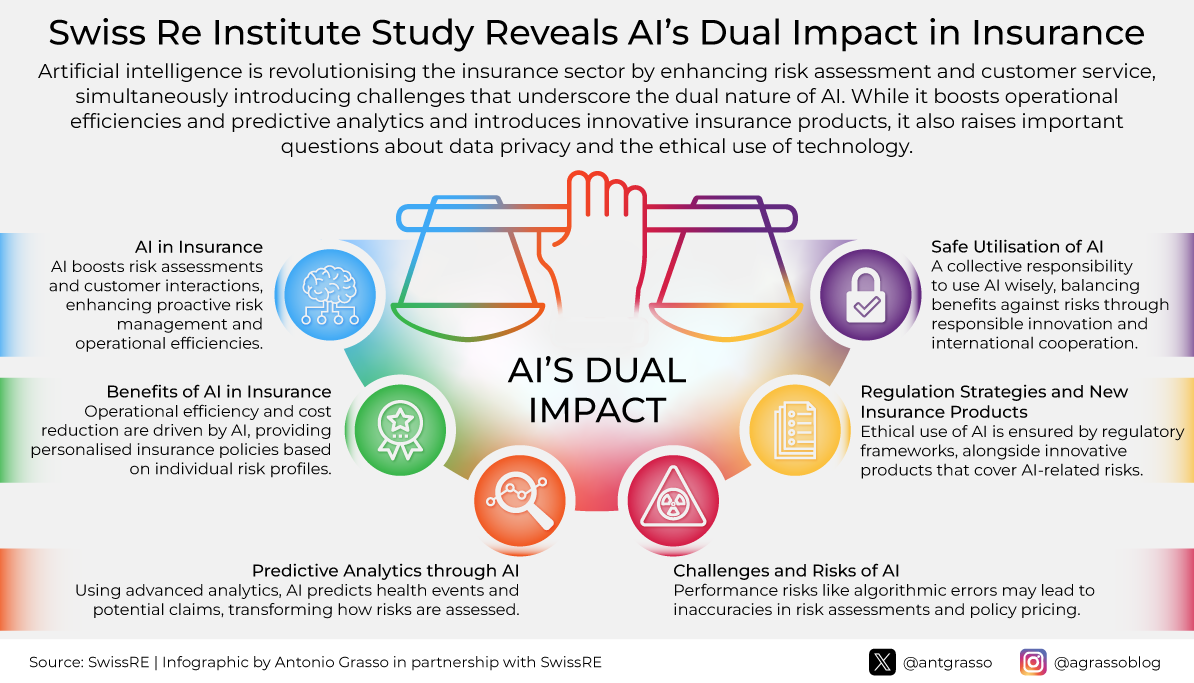
AI's dual impact in the insurance industry: opportunities and challenges
For businesses, AI is transforming how commercial auto insurance, general liability insurance, and professional liability insurance are priced. By analyzing industry-specific risk factors and operational data, AI can provide more accurate assessments that help businesses obtain appropriate coverage without overpaying. Even specialized insurance products like cyber liability insurance and errors and omissions insurance benefit from AI's ability to analyze digital footprints and operational patterns.
Enhancing Customer Experience Through AI
Beyond risk assessment, AI is dramatically improving the customer experience across the insurance journey. Chatbots and virtual assistants now handle routine inquiries about business insurance, renters insurance, and motorcycle insurance 24/7, providing instant responses and freeing human agents to address more complex issues.
Claims processing, once a lengthy and often frustrating process, has been streamlined through AI. Computer vision algorithms can assess vehicle damage from photos, while natural language processing can extract relevant information from claim documents. This results in faster payouts and greater transparency for customers filing claims for everything from travel insurance to pet insurance.
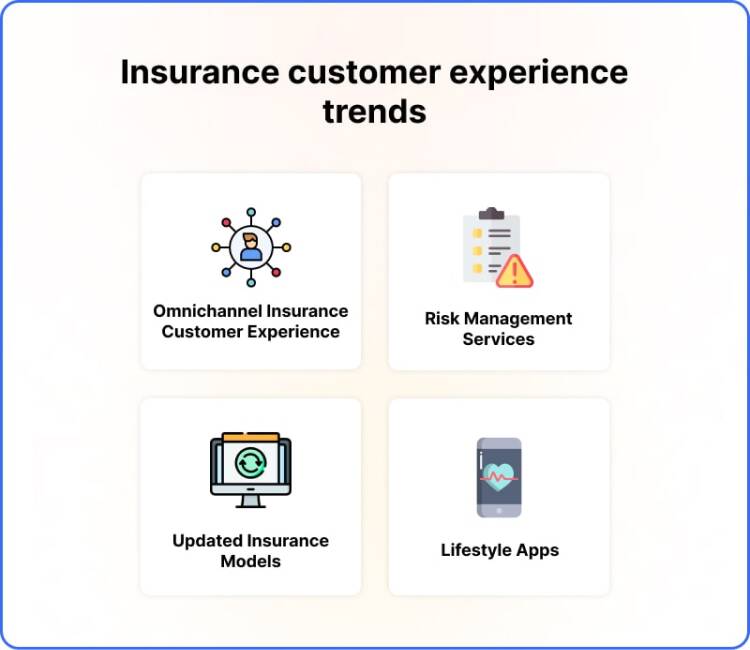
Four key trends transforming insurance customer experience through AI
Personalization has reached new heights with AI-driven recommendation engines that suggest appropriate coverage based on a customer's specific needs and life stage. Whether it's flood insurance for a homeowner in a high-risk area or disability insurance for a young professional, AI ensures customers receive relevant offers at the right time.
AI Applications Across Insurance Segments
The impact of AI extends across virtually every insurance segment. In health insurance, AI is helping providers optimize individual health insurance and family health insurance plans by predicting healthcare utilization and identifying preventive care opportunities. Medicare plans, Medicare Advantage, and Medicare Supplement offerings are being refined through AI analysis of population health data.
For property insurance, AI-powered satellite imagery and weather data are improving earthquake insurance and flood insurance risk models. Landlord insurance, condo insurance, and mobile home insurance providers are using AI to assess property-specific risks more accurately.
Even niche insurance products are being enhanced through AI. Classic car insurance providers use computer vision to verify vehicle authenticity and condition, while RV insurance and boat insurance companies incorporate telematics data for usage-based pricing. Wedding insurance providers are leveraging weather prediction models to price event cancellation coverage, and drone insurance companies use AI to assess flight risk based on location and operator experience.
The Future of AI in Insurance
As AI technology continues to evolve, its impact on insurance will only deepen. Generative AI is already being used to create personalized policy documents and explain complex coverage terms in plain language. We're seeing the emergence of no medical exam life insurance products that rely entirely on AI-driven risk assessment.
The insurance industry is also developing new products to address AI-related risks, including cyber liability insurance specifically for AI system failures and professional liability insurance for AI implementation errors. Long-term care insurance and critical illness insurance are being refined through AI's ability to predict health trajectories with greater accuracy.
However, the integration of AI also presents challenges, including ethical concerns about data privacy, the potential for algorithmic bias, and regulatory hurdles. The most successful insurers will be those that balance technological innovation with human oversight and maintain transparency in their AI-driven processes.
Conclusion
AI is not just an incremental improvement for the insurance industry—it's a transformative force that is reshaping how risk is assessed, priced, and managed. From umbrella insurance to workers' compensation insurance, AI is enabling more accurate risk models, more personalized products, and more efficient operations. For consumers, this means more relevant coverage, fairer pricing, and faster service. For insurers, it means greater operational efficiency, reduced fraud, and the ability to develop innovative products that address emerging risks. As AI technology continues to evolve, the insurance industry will undoubtedly continue to transform, creating new opportunities and challenges for providers and policyholders alike.
