
What happens when a self-driving car gets into an accident—who is responsible when there's no human driver at the wheel?
Understanding Autonomous Vehicle Insurance
Autonomous Vehicle Insurance represents a revolutionary approach to auto insurance quotes as self-driving technology continues to advance. Unlike traditional auto insurance that primarily focuses on human driver behavior, autonomous vehicle insurance must address the complex interplay between human oversight, artificial intelligence, and sophisticated sensor systems that power self-driving cars.

Self-driving technology is reshaping how we think about vehicle insurance
As vehicles become increasingly automated, the insurance industry faces unprecedented challenges in determining liability, assessing risk, and developing appropriate coverage models. The fundamental question of who bears responsibility when an autonomous vehicle causes an accident—whether it's the owner, manufacturer, software developer, or a combination of parties—has created a paradigm shift in how insurance products are structured and priced.
Levels of Vehicle Automation and Insurance Implications
The Society of Automotive Engineers (SAE) has defined six levels of vehicle automation, each with distinct insurance considerations:
- Level 0 (No Automation): Traditional vehicles with standard auto insurance models.
- Level 1 (Driver Assistance): Features like adaptive cruise control, where the driver remains primarily responsible.
- Level 2 (Partial Automation): Systems like Tesla's Autopilot that can control steering and acceleration but require driver attention.
- Level 3 (Conditional Automation): Vehicles that can drive themselves under certain conditions but may require human intervention.
- Level 4 (High Automation): Vehicles that can operate without human input in specific conditions or geographic areas.
- Level 5 (Full Automation): Completely self-driving vehicles that require no human intervention under any conditions.
As vehicles progress through these automation levels, insurance models must evolve to address the shifting balance of responsibility between human drivers and automated systems. Currently, most insurance policies for vehicles with Levels 1-3 automation still place primary responsibility on the human driver, but this is expected to change as higher levels of automation become mainstream.
Liability Challenges in Autonomous Vehicle Insurance
One of the most significant challenges in autonomous vehicle insurance is determining liability in accidents involving self-driving cars. Traditional insurance models are built around the concept of driver negligence, but this framework becomes increasingly problematic as vehicles become more autonomous.
Potential liability scenarios include:
- Manufacturer Liability: Defects in the vehicle's hardware or autonomous systems.
- Software Developer Liability: Errors in the code that controls the vehicle's autonomous functions.
- Owner Liability: Failure to maintain the vehicle properly or override autonomous systems when necessary.
- Third-Party Liability: Issues with connected infrastructure or other external factors.
Some experts predict that as vehicles become fully autonomous, insurance may shift from individual policies to product liability insurance held by manufacturers, similar to how other consumer products are insured today.
Emerging Insurance Models for Autonomous Vehicles
The insurance industry is developing innovative approaches to address the unique challenges posed by autonomous vehicles:
- Hybrid Policies: Coverage that adapts based on the level of automation being used at the time of an incident.
- Data-Driven Pricing: Using telematics and vehicle data to more accurately assess risk and determine premiums.
- Manufacturer-Backed Insurance: Some automakers are offering their own insurance products specifically designed for their autonomous vehicles.
- Cyber Liability Coverage: Protection against hacking, malware, or other cyber threats that could compromise vehicle systems.
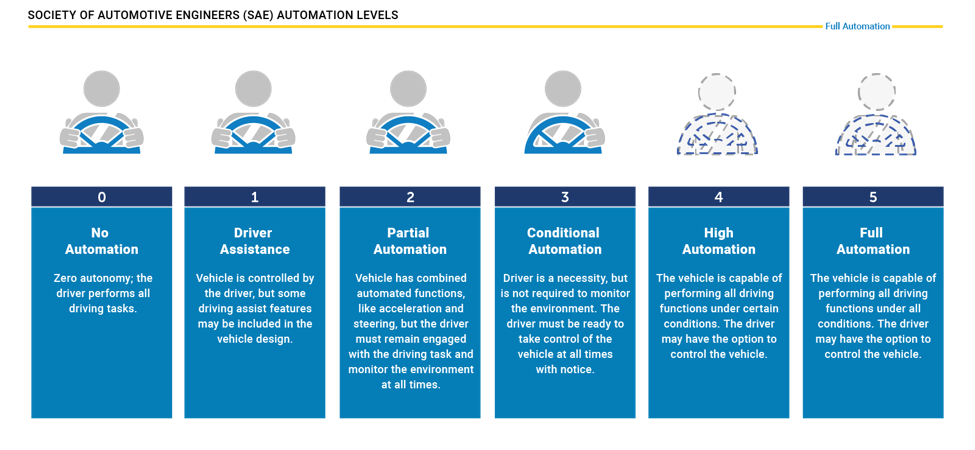
The six levels of vehicle automation, each with distinct insurance considerations
These emerging models reflect the industry's recognition that traditional auto insurance approaches may be insufficient for the autonomous vehicle era. Insurers are collaborating with automakers, technology companies, and regulators to develop comprehensive solutions that address the complex risk landscape of self-driving cars.
Implications for Business Insurance
The rise of autonomous vehicles also has significant implications for business insurance, particularly for companies that:
- Operate vehicle fleets (delivery services, ride-sharing, transportation companies)
- Manufacture autonomous vehicle technology
- Develop software or components for autonomous systems
- Provide maintenance or repair services for autonomous vehicles
These businesses face unique risks that require specialized insurance products. For example, commercial auto insurance for autonomous vehicle fleets must address questions of liability when vehicles operate without human drivers. Technology companies need errors and omissions insurance that covers potential failures in their autonomous systems, and manufacturers may require enhanced product liability insurance to address the complex nature of autonomous vehicle technology.
Conclusion: Navigating the Future of Autonomous Vehicle Insurance
Autonomous Vehicle Insurance represents one of the most significant transformations in the insurance industry's history. As self-driving technology continues to evolve, insurance models must adapt to address the complex interplay between human oversight and automated systems.
While the full impact of autonomous vehicles on insurance remains to be seen, it's clear that the industry is moving toward more personalized, data-driven coverage models that reflect the actual risk profile of each vehicle and situation. For consumers and businesses alike, staying informed about these developments will be essential to ensure adequate protection as we transition to a more autonomous transportation future.